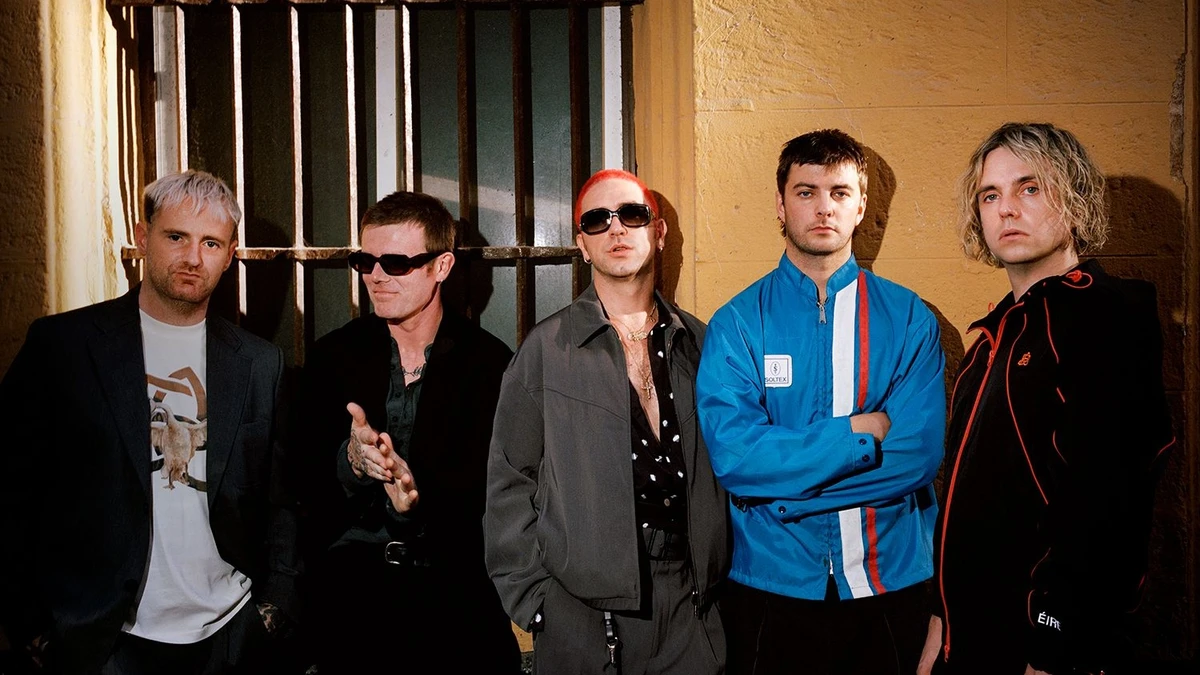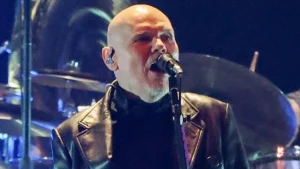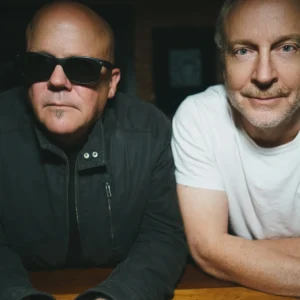


Bloc Party.
Bloc Party.
The guitars on “Coming On Strong” arrive with more air around them than a Bloc Party single usually gets. That is Trevor Horn’s room, and it is the first thing you notice about Anatomy of a Brief Romance, the band’s seventh album, out on 11 September.
Horn produced it. His credits run through Grace Jones, Pet Shop Boys and Frankie Goes To Hollywood, which is a very deliberate choice for a band that made its name on tightly wound post-punk guitars and a rhythm section that never sat still. The record is being released on cOnTAGIOUS LTD, the band’s own newly formed label, through Virgin Music Group.
Trevor Horn in the Room
Pairing Bloc Party with Horn is the sort of decision that reads as odd on paper and obvious on playback. Horn’s signature is space and staging: he built records in the 1980s where the drums were an event and the arrangement had architecture. Bloc Party’s default setting is the opposite, four players compressed into as little room as possible.
What the pairing produces on the lead single is a Bloc Party track with the parts pulled apart far enough to hear each one. The rhythm section still drives it, but the guitars sit in a wider field, and the vocal is placed forward rather than fighting the band. NME has referred to the record as a “disco heartbreak” album, and the framing fits the production before it fits the lyrics.
It is also the band’s first proper full-length since 2022’s Alpha Games. In between they have revisited their own catalogue, issuing special editions of 2007’s A Weekend In The City and their 2005 debut Silent Alarm. Coming out of a period spent re-examining old records, hiring a producer known for building new ones from the ground up is a legible move.
A Tracklist That Starts With a Date
The fourteen songs run: “22.01.22”, “Coming On Strong”, “Love Bombs”, “Pigwig”, “Lagoon Blue”, “Muscleworks”, “Clark Kent”, “Worst Birthday Ever”, “Not Your Problem”, “Now We Can’t Be Friends”, “Rotherhithe”, “Stories”, “Moving On” and “Eulogy”.
Opening on a date and closing on “Eulogy” is not an accident. The band describe the album as a chronological portrait of a love affair that progresses from the first glances through to the heartbreak and the final farewell, and the sequence delivers exactly that. “Love Bombs” sits at three. “Now We Can’t Be Friends” sits at ten. “Moving On” is the penultimate track.
The titles in between are more specific than a break-up record usually allows itself. “Rotherhithe” names a stretch of south-east London. “Worst Birthday Ever” names an occasion. “Muscleworks” and “Pigwig” read like private references, which the band have said is the point: the record carries inside jokes, barbs and small details rather than generalised sentiment.
What Okereke Decided to Say Out Loud
Kele Okereke has been unusually direct about the source material. “Every lyric you’re hearing on this record was something that actually happened to me. I had to tell the story, from start to finish,” he said when the album was announced.
The story he is telling is the end of a relationship of more than a decade with the father of his children, and an unexpected romance that followed it. He has described that new relationship as the thing that kept him sane during a very dark period, which is a plainer statement than he has historically made in public about his own life.
He has also said he is less prudish now about sex, connection and intimacy than he used to be, and has no qualms discussing it, because that connection matters. He does not think he has ever been that candid before. For a songwriter whose earlier work often approached the personal at an angle, that is the actual news in the announcement.
The band’s own summary of the record leans into the physical rather than the confessional: full of bodies, they say, from the gym to the dancefloor to the bedroom. Those three rooms map neatly onto Horn’s production, which is why the album can be a memoir and still work on a floor.
Their Own Label, Their Seventh Record
cOnTAGIOUS LTD is new, and it is theirs. Releasing a seventh album on a label the band control, distributed through Virgin Music Group, is a structural choice as much as a commercial one. It puts the sequencing, the artwork and the release timing inside the band rather than in a conversation with an A&R department.
That matters more than usual for a record built as a chronological account. An album whose whole argument depends on running in one specific order is vulnerable to anyone who wants a single moved forward or a slower track cut. Owning the label removes that conversation entirely.
It also fits where Bloc Party sit commercially. Twenty-one years after Silent Alarm, the band have an audience that arrives for albums rather than for playlist placements, and the arena tour attached to this cycle confirms it. A label of their own is a reasonable answer to that position.
Fourteen Songs and the Problem of Length
Fourteen tracks is long for a modern rock album, and long for Bloc Party specifically. Silent Alarm ran thirteen and moved fast. A fourteen-song chronological narrative is a different proposition: it needs the middle to hold, because the shape only pays off if a listener reaches “Eulogy”.
This is where the memoir structure becomes a risk as well as a hook. A record organised by events rather than by pacing can stall wherever the events did, and the writing has to carry stretches that a conventionally sequenced album would simply cut. The band have accepted that trade openly by describing the album as a memoir rather than a collection.
The counterweight is Horn. A producer who thinks in arrangement rather than in takes is exactly the person to keep fourteen tracks distinguishable from one another, and the range implied by the titles suggests the record moves between registers rather than settling into one tempo for an hour.
The device is not new but it is rarely done straight. Records that reorder or re-examine a timeline have been a recurring thread on this site, from an album that takes its own timeline back to any number of break-up sequences that hide the chronology. Bloc Party are doing the opposite of hiding it.
Arenas in November
The touring behind the record is a UK and European co-headline run with Interpol, eighteen dates announced for November. It opens at the Utilita Arena in Birmingham on 20 November and moves to Cardiff the following night before continuing through the rest of the schedule.
A co-headline arena tour with a band of Interpol’s standing is the clearest signal of where Bloc Party’s audience sits now. Both groups arrived in the same early-2000s window, both have catalogues their crowds know completely, and pairing them fills rooms neither would fill alone at this point in the cycle.
It also means the new songs will be introduced in large rooms rather than club shows. A chronological break-up album played to an arena is an unusual staging problem, and the Horn production is at least built for the scale. DIY published the full tracklist and tour dates when the album was announced in May, alongside NME’s interview with Okereke and Consequence’s report on the label launch.
About Author